Ask a CISO where their real DORA exposure sits and the honest answer is often “the systems we cannot easily change”. Decades-old core platforms, brittle integrations and undocumented dependencies are exactly what DORA’s resilience requirements stress-test. Application modernization is not just an IT efficiency project, done right, it is one of the most effective ways to reduce ICT risk under DORA.
Why legacy is a DORA problem
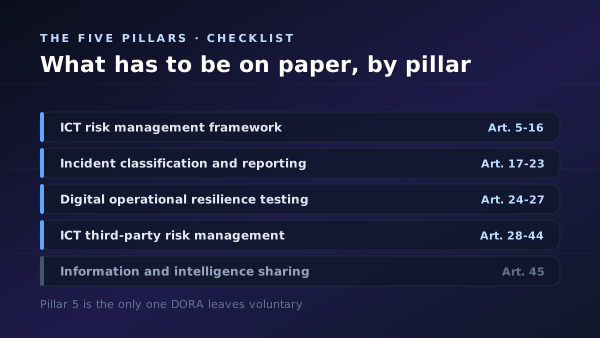
DORA expects entities to identify their ICT assets and dependencies (Article 8), detect and recover from incidents (Articles 10–12) and test resilience on critical systems (Articles 24–25). Legacy estates make all four harder: dependencies are opaque, monitoring is patchy, recovery is manual and slow, and testing a fragile monolith on a live system is risky in itself.
Modernization moves that map to DORA
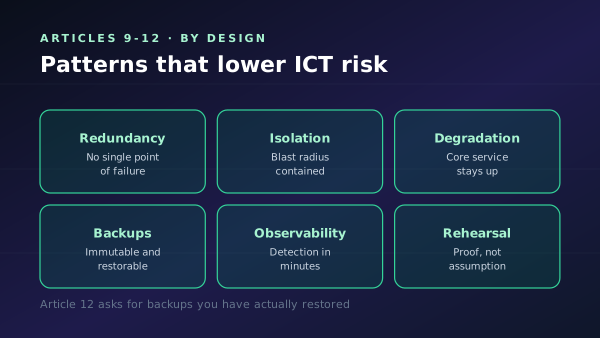
- Decouple the monolith. Isolating critical functions into well-bounded services limits blast radius, a failure in one area no longer takes down the whole platform (Pillar 1 protection, Pillar 3 testability).
- Make dependencies explicit. Modernization forces you to map what depends on what, the same map DORA wants for asset and dependency identification (Art. 8).
- Automate recovery. Infrastructure-as-code, immutable deployments and tested restore paths turn a multi-hour manual recovery into minutes: directly improving RTO/RPO (Art. 11–12).
- Bake in observability. Modern platforms emit structured logs, metrics and traces by default, the foundation of DORA detection (Art. 10) and of fast, evidenced incident reporting.
A pragmatic roadmap (you do not boil the ocean)
- Scope by criticality. Start with the systems that support critical or important functions, not everything.
- Reduce risk before rewriting. Wrap legacy with APIs, add monitoring, and test recovery first. Quick resilience wins often beat a multi-year rewrite.
- Modernize on the critical path. Prioritise the components whose failure would breach RTO or trigger a major incident.
- Prove it with testing. Each modernized component should be demonstrably more testable and recoverable: that is the DORA payoff.
Sustain it, do not just ship it
Resilience decays without continuous attention: dependencies drift, monitoring gaps reappear, recovery plans go stale. This is where specialised tooling helps, platforms like Resiplan keep the register, continuity and incident workflow current so a modernization gain does not quietly erode.
Go deeper
The ICT Risk Management Professional certification covers the framework, controls and continuity expectations modernization should serve. See also our guide to architecture choices that reduce ICT risk.