Most compliance checklists fail the same way. They list what to do, the list gets ticked, and nothing is left behind. A competent authority does not ask whether you have an ICT risk management framework: it asks to see it, approved, dated, and by a named person. This checklist is built the other way round. Every line pairs an obligation under Regulation (EU) 2022/2554, the Digital Operational Resilience Act (DORA), with the article that imposes it and the artefact that closes it. Work through it and you finish holding an evidence pack rather than a tick list.
How to use this checklist
Each line asks three questions in order: what does the regulation require, where does it say so, and which document in your estate answers it. The third question is the one that decides. If you cannot name the file, its version and its owner, the line is not done. A control that exists in practice but not on paper is indistinguishable, from the outside, from a control that does not exist.
Two calibrations apply before you start. Article 4 requires the framework to be implemented proportionately, taking account of your size, overall risk profile, and the nature, scale and complexity of your services. Article 16 goes further for the categories of entity it names, setting out a simplified ICT risk management framework. Neither is a discount on evidence: a proportionate control still has to be written down, and the reasoning that made it proportionate is itself an artefact worth keeping.
If you would rather score your position first and read afterwards, the interactive DORA compliance checklist walks the same ground as a self-assessment and keeps your progress in the browser. This article is the reference behind it: what each item means, and what closes it.
The five pillars at a glance
| Pillar | Articles | The question it answers |
|---|---|---|
| ICT risk management | Art. 5 to 16 | Do you know what you run, and can you protect, detect, respond and recover? |
| ICT-related incident management and reporting | Art. 17 to 23 | When something breaks, do you classify it correctly and tell the right authority in time? |
| Digital operational resilience testing | Art. 24 to 27 | Have you proved the controls work, on the systems that matter? |
| ICT third-party risk management | Art. 28 to 44 | Do you know who you depend on, on what terms, and how you would leave? |
| Information and intelligence sharing | Art. 45 | If you share threat intelligence, is the arrangement governed? |
Only the first four carry obligations every financial entity must meet. Article 45 is drafted as a permission rather than a duty, which changes what you have to show. That distinction is covered in its own section below, because presenting a voluntary arrangement as a mandatory control is a common and avoidable finding.
Step 0: settle scope before you tick anything
Scope decisions govern every line that follows. An entity that starts building controls before it has written down which category it falls into, and which of its functions are critical or important, ends up with a framework nobody can defend because nobody can explain what it covers.
| Obligation | Legal basis | Evidence that closes it |
|---|---|---|
| Establish that your entity is in scope, and under which category | Art. 2 | A dated scope note naming the Article 2 category or categories that apply, and who approved it |
| Determine whether the simplified framework is available to you | Art. 16 | The assessment against the Article 16 conditions, with the conclusion and the sign-off date |
| Identify your critical or important functions (CIFs) | Art. 3(22) | A decision record per function: the function in one line, the reasoning limb by limb, the conclusion, the approver |
| Name the accountable member of the management body | Art. 5(2) | Minutes naming a person, not a committee |
The definition at Article 3(22) is the hinge of the whole regulation. A function is critical or important where a disruption would materially impair the financial performance of the entity, or the soundness or continuity of its services and activities, or where discontinued or defective performance would materially impair continued compliance with the conditions and obligations of its authorisation. Any single limb is enough. Run the test explicitly, function by function, and write the reasoning down: our guide to evidencing CIF designations sets out what that record contains, and the critical or important functions guide works through the definition itself.
Pillar 1: ICT risk management (Articles 5 to 16)
This is the largest pillar by article count and by effort. It is also the one where checklists most often drift into generic security hygiene. Encryption and multi-factor authentication belong here, but they are not what a reviewer opens first. They open the framework document and look for a date, a version and an approval.
Governance and framework
| Obligation | Legal basis | Evidence that closes it |
|---|---|---|
| The management body defines, approves, oversees and remains accountable for the ICT risk management framework | Art. 5(2) | Board minutes recording approval, referencing the version approved |
| Management body members keep their ICT risk knowledge current through regular specific training | Art. 5(4) | A board training log: date, topic, provider, duration, attendee |
| Maintain a sound, comprehensive and documented ICT risk management framework | Art. 6 | The framework document, versioned, with an owner |
| Review the framework at least yearly, and after any major ICT-related incident | Art. 6(5) | Review records showing both triggers, not only the calendar one |
| Set out a digital operational resilience strategy explaining how the framework is implemented | Art. 6 | The strategy document, traceable to the framework it implements |
| Have the framework audited by ICT-skilled auditors on a regular basis | Art. 6 | The audit plan, the reports, and a follow-up log closing the findings |
The follow-up log is the item most often missing. An internal audit report with open findings and no closure trail reads, to a supervisor, as a control that identified a problem and stopped there.
Identification
| Obligation | Legal basis | Evidence that closes it |
|---|---|---|
| Identify, classify and document all ICT-supported business functions, roles and responsibilities | Art. 8 | The function inventory, linked to the CIF decision records |
| Identify the information assets and ICT assets supporting those functions, and their dependencies | Art. 8 | An asset register that maps assets to functions, reviewed on a defined cadence |
| Identify sources of ICT risk and assess cyber threats and vulnerabilities relevant to those functions | Art. 8 | Risk assessments dated and attributable, feeding a maintained ICT risk register |
Article 8 is where most programmes underestimate the work. Mapping assets to functions is not an inventory export: it is the join between what the business does and what the technology runs, and it is the input to every later pillar. Testing scope, register entries and impact tolerances all read from it. Our walkthrough of mapping ICT assets and functions covers the sequence, and setting defensible impact tolerances covers the thresholds that follow.
Protection and prevention
| Obligation | Legal basis | Evidence that closes it |
|---|---|---|
| Design and implement ICT security policies, procedures, protocols and tools | Art. 9 | The policy set, approved and in force, with review dates |
| Protect the confidentiality, integrity and availability of data, in transit and at rest | Art. 9 | The cryptographic and data protection standard, plus evidence of application on CIF-supporting systems |
| Implement identity management and access control, restricting access on need-to-know and least-privilege terms | Art. 9 | The access control policy, a current privileged access inventory, and the last recertification run |
| Manage changes to ICT systems under a documented process | Art. 9 | Change records showing assessment, approval and testing before production |
| Manage patches and updates on a defined cycle | Art. 9 | Patch policy with target windows, and exception records where the window is missed |
Access recertification and change approval are the two lines here that generate real findings, because both leave dated trails that either exist or do not. Change governance is worth its own attention where production data is involved: see database change governance under DORA.
Detection
| Obligation | Legal basis | Evidence that closes it |
|---|---|---|
| Have mechanisms to promptly detect anomalous activities, including performance issues and ICT-related incidents | Art. 10 | The monitoring design: what is monitored, what triggers an alert, and where the alert lands |
| Set alert thresholds and criteria that trigger incident detection and response processes | Art. 10 | Documented thresholds, and the last review that revisited them |
| Devote sufficient resources and capabilities to monitor user activity and ICT anomalies | Art. 10 | The staffing and coverage model, including out-of-hours arrangements |
The out-of-hours line matters more than it looks. Pillar 2 runs on a clock that starts when an incident is classified as major, and classification cannot wait for Monday morning.
Response, recovery and continuity
| Obligation | Legal basis | Evidence that closes it |
|---|---|---|
| Put in place a comprehensive ICT business continuity policy | Art. 11 | The policy, approved by the management body, with recovery objectives per function |
| Implement ICT response and recovery plans, and test them | Art. 11 | Plans plus dated test reports, including the issues the test surfaced |
| Maintain backup policies and procedures, and restoration and recovery procedures | Art. 12 | The backup standard, and restoration test evidence rather than backup job logs |
| Keep redundant ICT capacity adequate to support business needs | Art. 12 | The capacity and redundancy assessment for CIF-supporting systems |
Backups that run are not backups that restore. The evidence that closes the Article 12 line is a restoration test on a system that supports a critical or important function, with a measured recovery time compared against the objective you set.
Learning, evolving and communication
| Obligation | Legal basis | Evidence that closes it |
|---|---|---|
| Gather information on vulnerabilities, cyber threats and incidents, and conduct post-incident reviews | Art. 13 | Post-incident review records, with the changes they produced |
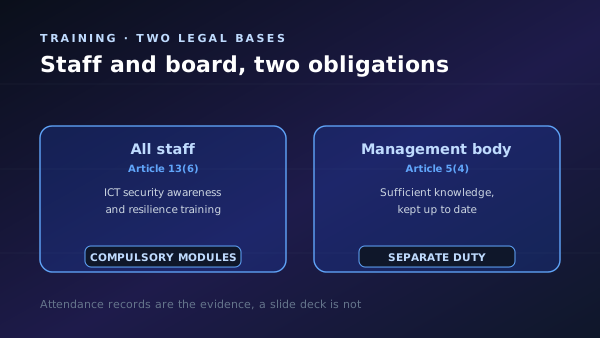
| Run ICT security awareness programmes and digital operational resilience training as compulsory modules | Art. 13(6) | The training scheme naming the modules as compulsory, plus completion records per person |
| Have crisis communication plans for disclosing incidents to clients, counterparts and the public | Art. 14 | The communication plan, with a named spokesperson and pre-approved holding statements |
Article 13(6) is the line most often treated as optional, and it is not: the wording makes the modules compulsory within the staff training scheme, covering all employees and senior management, with provision for including ICT third-party service providers where appropriate. The separate board duty sits at Article 5(4). Both are set out in detail in our guide to DORA training requirements for board and staff.
Pillar 2: incident management and reporting (Articles 17 to 23)
This pillar is judged on timing, and timing is judged on records. Every deadline runs from a moment somebody decided something, which means the decision needs a timestamp and an owner.
| Obligation | Legal basis | Evidence that closes it |
|---|---|---|
| Define and implement an ICT-related incident management process to detect, manage and notify incidents | Art. 17 | The process document, with roles, escalation path and a named duty decision-maker |
| Record all ICT-related incidents and significant cyber threats | Art. 17 | An incident log covering the full population, not only the reported ones |
| Classify incidents against the criteria set out in the regulation and the technical standards | Art. 18 | The classification methodology, and the completed classification record per incident |
| Report major ICT-related incidents to the competent authority | Art. 19 | Submitted initial, intermediate and final reports, with timestamps |
| Inform affected clients without undue delay where a major incident affects their financial interests | Art. 19 | The client communication, dated, with the distribution list |
| Decide your position on voluntary notification of significant cyber threats | Art. 19 | A written position, applied consistently |
The reporting timeline runs in three stages: an initial notification within four hours of classifying the incident as major and no later than 24 hours after becoming aware of it, an intermediate report within 72 hours, and a final report within one month. The clock starts at classification, which is precisely why classification cannot be allowed to drift: delaying the decision does not delay the deadline. The practical readiness test is whether a named person, reachable at three in the morning on a Sunday, is empowered to classify an incident as major without convening anybody. Our step-by-step incident reporting guide covers the submission mechanics, and the RTS on incident reporting sets out the classification criteria in full.
Pillar 3: digital operational resilience testing (Articles 24 to 27)
Testing is where scope decisions made in Article 8 come back to be checked. If the asset-to-function mapping is thin, the testing programme cannot be shown to cover the right systems, and the whole pillar becomes hard to defend.
| Obligation | Legal basis | Evidence that closes it |
|---|---|---|
| Establish a sound and comprehensive digital operational resilience testing programme | Art. 24 | The programme document: scope, methods, cadence, and who executes it |
| Test all ICT systems and applications supporting critical or important functions at least yearly | Art. 24(6) | A coverage matrix: every CIF-supporting system, its last test, and the test type |
| Apply a risk-based approach covering vulnerability assessments, network security assessments, gap analyses, scenario-based tests and other appropriate tests | Art. 25 | Test reports by type, with findings and remediation status |
| Establish whether your entity is identified for threat-led penetration testing (TLPT) | Art. 26 | The designation correspondence, or a documented position where you have not been identified |
| Where identified, conduct TLPT at least every three years on live production systems covering critical or important functions | Art. 26 | Scope specification, the test report, and the attestation from the authority |
| Use testers meeting the requirements set out in the regulation | Art. 27 | Tester credentials, independence declarations and professional indemnity cover on file |
Two distinctions save time here. The yearly obligation at Article 24(6) applies to every entity in scope and attaches to systems supporting critical or important functions. TLPT under Article 26 applies only to entities identified for it by the competent authority, and runs on a three-year cycle. Conflating the two produces either an over-engineered programme or a gap, depending on which way the confusion runs. The TLPT reference page covers designation and the TIBER-EU alignment, and the phase-by-phase TLPT methodology covers execution.
Pillar 4: ICT third-party risk management (Articles 28 to 44)
This pillar carries the longest lead times of the five. Contract repapering depends on counterparties who have their own queues, and the Register of Information depends on data that usually lives in several systems that were never designed to be joined. Both are measured in months.
| Obligation | Legal basis | Evidence that closes it |
|---|---|---|
| Manage ICT third-party risk as an integral part of the ICT risk framework, under a documented strategy | Art. 28(1) | The third-party risk policy, approved and in force |
| Maintain a Register of Information (RoI) on all contractual arrangements for the use of ICT services | Art. 28(3) | The register itself, complete, current, and reportable to the competent authority on request |
| Distinguish arrangements that support critical or important functions from those that do not | Art. 28(3) | The flag in the register, traceable to the CIF decision record behind it |
| Conduct due diligence before entering a contractual arrangement | Art. 28 | The pre-contract assessment, dated before signature |
| Assess concentration risk, including at group level | Art. 29 | The concentration analysis, covering substitutability and fourth-party dependencies |
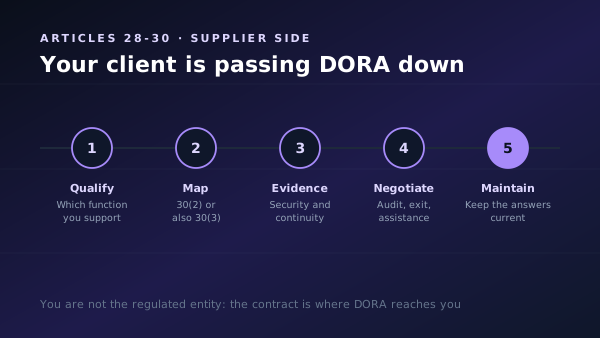
| Include the mandatory contractual provisions in every ICT services contract | Art. 30(2) | A clause-to-contract mapping showing where each provision sits |
| Include the enhanced provisions where the service supports a critical or important function | Art. 30(3) | The same mapping against the enhanced set: service levels, audit and access rights, data location, exit assistance, cooperation with testing |
| Maintain exit strategies for arrangements supporting critical or important functions | Art. 28(8) | A per-provider exit plan with trigger conditions, transition steps, an owner and a tested assumption about how long it takes |
Two failure patterns dominate. The first is due diligence that stops at signature: a thorough pre-contract assessment, then no monitoring, no reassessment and no evidence of ongoing oversight. Article 28(1) frames third-party risk as continuous, and the register is the artefact that proves continuity. The second is the exit plan that exists as a paragraph. An exit strategy that has never been costed, sequenced or tested against a date will not survive a question about how long a migration would take. Our guides to the Register of Information submission and the third-party risk register methodology cover both artefacts in detail.
Articles 31 to 44 govern the oversight framework for ICT third-party service providers designated as critical (CTPPs) by the European Supervisory Authorities. Those articles bind the designated providers and their lead overseers rather than you, but two consequences reach your file: knowing whether any of your providers carries the designation, and understanding that the oversight recommendations issued to them may change the service you receive.
Pillar 5: information and intelligence sharing (Article 45)
Article 45 permits financial entities to exchange cyber threat information and intelligence among themselves, within trusted communities and under arrangements that protect the sensitive nature of what is shared. It is drafted as a permission, not an obligation, which is why the checklist line here is different in kind from the four pillars above.
| Obligation | Legal basis | Evidence that closes it |
|---|---|---|
| Decide whether to participate in information sharing arrangements | Art. 45 | A recorded decision, either way |
| Where you participate, operate within a governed arrangement protecting the confidentiality of what is shared | Art. 45 | The arrangement terms, the handling rules applied, and the data protection assessment |
| Notify the competent authority of your participation, or of its cessation, once validated | Art. 45 | The notification, dated |
A checklist that presents membership of a sharing community as a mandatory control overstates the regulation. A checklist that omits Article 45 entirely misses the notification duty that attaches once you do participate. Recording the decision, in either direction, closes the line.
The evidence pack a reviewer opens first
Across supervisory conversations and internal audits, the same small set of documents gets requested before anything else. Assembling them as a pack, rather than retrieving them under time pressure, is the single highest-return preparation a programme can make.
- The ICT risk management framework, with the board approval and the date of the last review.
- The list of critical or important functions, with the decision record behind each designation.
- The Register of Information, current, with the CIF flag populated.
- The incident log for the period, and the reports submitted for any major incident.
- The testing coverage matrix: every CIF-supporting system, its last test, and the outcome.
- The contract clause mapping against Articles 30(2) and 30(3).
- Exit plans for arrangements supporting critical or important functions.
- Training completion records, including the management body log under Article 5(4).
- The internal audit reports on the framework, with the follow-up log closing the findings.
Nine documents. If any of them cannot be produced in an afternoon, that is the finding, and it is better discovered by you than by somebody else.
Six checks that fail most often
- The CIF list has no reasoning behind it. Names of functions, no record of the Article 3(22) test. Everything downstream inherits the weakness.
- The register is a snapshot. Built for a deadline, accurate on the day, unmaintained afterwards. Article 28(3) expects a living artefact.
- Restoration was never tested. Backup jobs succeed, and nobody has measured a recovery against the objective.
- Classification has no owner out of hours. The four-hour clock cannot start if nobody is empowered to start it.
- Exit plans are paragraphs. No sequence, no cost, no tested duration, no owner.
- Board training is assumed. Article 5(4) is a duty of the members themselves, and it needs its own log rather than a line in the staff training report.
None of these are exotic. They are what happens when a programme optimises for coverage of a checklist rather than for the strength of the record behind each line.
On penalties, briefly
Article 50 requires Member States to give competent authorities the power to apply administrative penalties and remedial measures, and leaves the rules to national law. That means your exposure depends on your competent authority rather than on a single European figure, and it is why widely repeated percentage-of-turnover caps do not come from DORA. The detail, with the verbatim text, is set out in our guide to DORA penalties and enforcement.
Where certification fits
DORA nowhere requires a certificate. What Article 13(6) requires is training that happened, delivered as a compulsory module, with completion recorded per person; what Article 5(4) requires is that management body members maintain the knowledge to assess ICT risk. A verifiable certificate is the cleanest per-person evidence either duty can produce, and it doubles as the thing that gets a compliance professional recognised for work they already do.
The free DORA Fundamentals course covers the five pillars in the sequence this checklist follows and ends in a certificate, which makes it a workable baseline module for a whole team. Role-specific credentials go deeper where a remit demands it: ICT risk, third-party risk, incident reporting, TLPT, contract management. The full catalogue, with what each programme certifies, is on the DORA certification page.
Frequently asked questions
What are the five pillars of DORA?
ICT risk management (Articles 5 to 16), ICT-related incident management and reporting (Articles 17 to 23), digital operational resilience testing (Articles 24 to 27), ICT third-party risk management (Articles 28 to 44), and information and intelligence sharing (Article 45). The first four carry obligations for every financial entity in scope. Article 45 is drafted as a permission, with a notification duty attaching once you participate.
Is a DORA compliance checklist enough to demonstrate compliance?
No. A checklist organises the work; what demonstrates compliance is the artefact behind each line, with a version, a date and an owner. The useful test for any checklist item is whether you can name the file that closes it and produce it the same day.
How often must the ICT risk management framework be reviewed?
At least once a year under Article 6(5), and additionally after any major ICT-related incident. Review records that show only the annual cycle leave the second trigger unevidenced.
Does every financial entity have to run threat-led penetration testing?
No. TLPT under Article 26 applies to entities identified for it by the competent authority, on a cycle of at least every three years. The obligation that applies to everyone in scope is Article 24(6): appropriate testing of all ICT systems and applications supporting critical or important functions, at least yearly.
What goes in the Register of Information?
All contractual arrangements for the use of ICT services provided by ICT third-party service providers, under Article 28(3), with arrangements supporting critical or important functions distinguished from the rest. It is reportable to the competent authority, which is why completeness and currency matter more than presentation.
Is information sharing under Article 45 mandatory?
No. Article 45 permits financial entities to exchange cyber threat information and intelligence within trusted communities under protective arrangements. What it does require, once you participate, is notification of that participation, or of its cessation, to the competent authority.
Where should a programme start?
With scope: the Article 2 category, the availability of the Article 16 simplified framework, and the list of critical or important functions under Article 3(22). Testing scope, register entries, contractual provisions and impact tolerances all read from that list, so building them before it is settled means building them twice.