What Articles 5 to 16 require
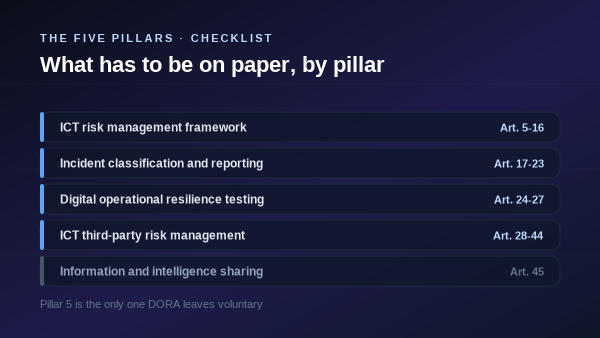
Chapter II of DORA holds the twelve articles of Pillar 1. Titles are the official ones; each obligation is summarised from the text of Regulation (EU) 2022/2554 on EUR-Lex.
| Article | Official title | Main obligation |
|---|---|---|
| Art. 5 | Governance and organisation | The management body defines, approves, oversees and is responsible for the implementation of all arrangements related to the ICT risk management framework, and bears the ultimate responsibility for managing ICT risk. |
| Art. 6 | ICT risk management framework | Have a sound, comprehensive and well-documented ICT risk management framework, as part of the overall risk management system, that includes a digital operational resilience strategy and is reviewed at least once a year. |
| Art. 7 | ICT systems, protocols and tools | Use and maintain updated ICT systems, protocols and tools that are appropriate to the magnitude of operations, reliable, equipped with sufficient capacity and technologically resilient. |
| Art. 8 | Identification | Identify, classify and adequately document all ICT supported business functions, roles and responsibilities, the information assets and ICT assets supporting them and their dependencies, and identify all sources of ICT risk. |
| Art. 9 | Protection and prevention | Continuously monitor and control the security and functioning of ICT systems and tools, and minimise the impact of ICT risk through appropriate ICT security tools, policies and procedures. |
| Art. 10 | Detection | Have mechanisms in place to promptly detect anomalous activities, including ICT network performance issues and ICT-related incidents, and to identify potential material single points of failure. |
| Art. 11 | Response and recovery | Put in place a comprehensive ICT business continuity policy, implemented through dedicated, appropriate and documented arrangements, plans, procedures and mechanisms, and test the plans at least yearly. |
| Art. 12 | Backup policies and procedures, restoration and recovery procedures and methods | Develop and document backup policies and procedures specifying the scope of the data subject to backup and the minimum frequency of the backup, together with restoration and recovery procedures and methods. |
| Art. 13 | Learning and evolving | Have the capabilities and staff to gather information on vulnerabilities, cyber threats and ICT-related incidents, review major ICT-related incidents after the event, and run compulsory ICT security awareness programmes and digital operational resilience training. |
| Art. 14 | Communication | Have crisis communication plans enabling a responsible disclosure of, at least, major ICT-related incidents or vulnerabilities to clients and counterparts and to the public, as appropriate. |
| Art. 15 | Further harmonisation of ICT risk management tools, methods, processes and policies | No direct obligation on financial entities: it mandates the European Supervisory Authorities to draft the regulatory technical standards (RTS) that became Delegated Regulation (EU) 2024/1774. |
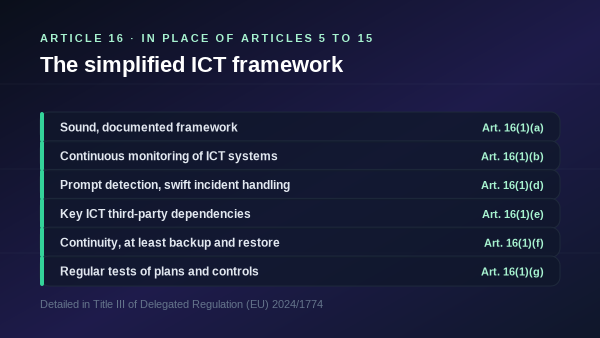
| Art. 16 | Simplified ICT risk management framework | Articles 5 to 15 do not apply to the entities it lists, which instead put in place and maintain a sound and documented simplified ICT risk management framework. |
How the RTS on ICT risk management adds detail
Articles 5 to 14 set the obligations; the regulatory technical standards give them their technical content. Commission Delegated Regulation (EU) 2024/1774, adopted on 13 March 2024 under the mandates of Articles 15 and 16(3), further specifies the ICT risk management tools, methods, processes and policies, and the simplified ICT risk management framework of Article 16. It has applied since 17 January 2025, the date DORA itself started to apply. Our page on the RTS on ICT risk management (Delegated Regulation 2024/1774) walks through its requirements with implementation checklists.
Understanding the Requirements
Article 6 requires the framework itself; Articles 8 to 14 then set what it has to cover:
- ICT risk identification, assessment, and mitigation
- Protection and prevention measures
- Detection mechanisms
- Response and recovery capabilities
- Learning and evolving processes
- Communication and reporting
Article 6 in practice
Four paragraphs of Article 6 carry most of the evidence a competent authority will ask to see:
- Article 6(4), independence: financial entities other than microenterprises assign the responsibility for managing and overseeing ICT risk to a control function with an appropriate level of independence, to avoid conflicts of interest. Financial entities also ensure appropriate segregation and independence of ICT risk management functions, control functions and internal audit functions, according to the three lines of defence model or an internal risk management and control model.
- Article 6(5), review: the framework is documented and reviewed at least once a year (periodically for microenterprises), upon the occurrence of major ICT-related incidents, and following supervisory instructions or conclusions derived from relevant digital operational resilience testing or audit processes. It is continuously improved on the basis of lessons derived from implementation and monitoring, and a report on the review is submitted to the competent authority upon its request.
- Article 6(6), internal audit: for financial entities other than microenterprises, the framework is subject to internal audit by auditors on a regular basis, in line with the audit plan. The auditors have sufficient knowledge, skills and expertise in ICT risk and appropriate independence, and the frequency and focus of ICT audits are commensurate to the ICT risk of the entity. Article 6(7) adds a formal follow-up process for critical ICT audit findings.
- Article 6(8), strategy: the framework includes a digital operational resilience strategy setting out how it is implemented. The strategy explains how the framework supports the business strategy and objectives; establishes the risk tolerance level for ICT risk, in line with the risk appetite, and analyses the impact tolerance for ICT disruptions; sets clear information security objectives, including key performance indicators and key risk metrics; explains the ICT reference architecture and any changes needed to reach business objectives; outlines the mechanisms to detect ICT-related incidents, prevent their impact and provide protection; evidences the current digital operational resilience situation on the basis of the number of major ICT-related incidents reported and the effectiveness of preventive measures; implements digital operational resilience testing under Chapter IV; and outlines a communication strategy for the ICT-related incidents whose disclosure is required under Article 14.
In practice, keep one evidence file per paragraph: the mandate and reporting line of the control function (6(4)), dated review records showing every trigger and not only the calendar one (6(5)), the audit plan and its findings log (6(6) and 6(7)), and the approved strategy document mapped to points (a) to (h) (6(8)).
Step 1: Governance and Organization (Articles 5 and 6)
Establish Clear Accountability
Your framework must define:
- Management Body Responsibility: The board must approve and oversee the ICT risk management framework
- Senior Management: Designate executives responsible for ICT risk implementation
- Three Lines of Defense: Define roles for business, risk management, and internal audit
- ICT Risk Function: Establish a dedicated function or team
Documentation Requirements
Maintain comprehensive documentation including:
- ICT risk management policy
- Roles and responsibilities matrix
- Decision-making processes
- Escalation procedures
Step 2: Asset and Dependency Mapping (Article 8)
Create ICT Asset Inventory
Document all ICT assets supporting business functions:
- Hardware infrastructure
- Software applications
- Data repositories
- Network components
- Third-party services
Map Critical Business Functions
For each critical business function, identify:
- Supporting ICT systems
- Data flows
- Dependencies and interconnections
- Recovery time objectives (RTO)
- Recovery point objectives (RPO)
Step 3: Risk Assessment Process (Article 8)
Risk Identification
Implement systematic risk identification covering:
- Internal threats (insider risks, system failures)
- External threats (cyberattacks, natural disasters)
- Third-party risks
- Emerging technologies and innovations
Risk Analysis and Evaluation
For each identified risk, assess:
- Likelihood: Probability of occurrence
- Impact: Potential consequences on business operations
- Risk Rating: Combined score determining priority
- Current Controls: Existing mitigation measures
- Residual Risk: Risk remaining after controls
Step 4: Protection and Prevention (Article 9)
Security Controls
Implement appropriate controls including:
- Access management and authentication
- Network security and segmentation
- Encryption for data at rest and in transit
- Patch management and vulnerability management
- Endpoint protection
- Security awareness training: compulsory modules under Article 13(6); see the DORA training requirements guide
Change Management
Establish procedures for:
- Assessing ICT changes before implementation
- Testing in non-production environments
- Rollback capabilities
- Documentation of changes
Step 5: Detection and Monitoring (Article 10)
Continuous Monitoring
Deploy capabilities to detect:
- Anomalous activities and security events
- Performance degradation
- Compliance deviations
- Unauthorized changes
Logging and Alerting
Implement comprehensive logging:
- Centralized log management
- Log retention policies
- Real-time alerting rules
- Security information and event management (SIEM)
Step 6: Business Continuity and Disaster Recovery (Articles 11 and 12)
Business Continuity Planning
Develop and maintain:
- Business impact analysis (BIA)
- Continuity strategies for critical functions
- Alternative processing arrangements
- Communication plans
Disaster Recovery
Establish robust recovery capabilities:
- Backup strategies (onsite and offsite)
- Recovery procedures
- Regular testing and validation
- Documentation and runbooks
Step 7: Testing and Validation (Articles 11 and 24 to 27)
DORA does not set a quarterly cycle for vulnerability assessments or an annual cycle for penetration tests as such. The frequencies it does set are these:
- Vulnerability assessments and penetration testing: both among the tests the digital operational resilience testing programme provides for (Article 25(1)), with no per-test frequency in DORA
- Appropriate tests of all ICT systems and applications supporting critical or important functions: at least yearly (Article 24(6))
- Business continuity exercises: ICT business continuity plans and ICT response and recovery plans tested at least yearly, and after substantive changes to ICT systems supporting critical or important functions (Article 11(6))
- Disaster recovery tests: backup procedures and restoration and recovery procedures and methods tested periodically (Article 12(2))
- Threat-led penetration testing (TLPT): at least every three years, for the financial entities identified by their competent authority (Article 26(1) and (8))
Step 8: Learning and Improvement (Article 13)
Post-Incident Reviews
After significant incidents:
- Conduct root cause analysis
- Document lessons learned
- Update procedures and controls
- Share insights across organization
Continuous Improvement
Regularly review and update:
- Risk assessments
- Control effectiveness
- Emerging threats and technologies
- Regulatory requirements
FAQ
What is an ICT risk management framework under DORA?
It is the sound, comprehensive and well-documented framework that Article 6(1) requires every financial entity to have, as part of its overall risk management system, so that it can address ICT risk quickly, efficiently and comprehensively. Under Article 6(2) it includes at least the strategies, policies, procedures, ICT protocols and tools necessary to duly and adequately protect all information assets and ICT assets.
How often must the framework be reviewed?
At least once a year, or periodically for microenterprises, and also upon the occurrence of major ICT-related incidents and following supervisory instructions or conclusions from digital operational resilience testing or audit processes (Article 6(5)). A report on the review is submitted to the competent authority upon its request. Entities under the simplified framework review it periodically and upon the occurrence of major ICT-related incidents (Article 16(2)).
Who is accountable for ICT risk?
The management body: it defines, approves, oversees and is responsible for the implementation of all arrangements related to the framework, and bears the ultimate responsibility for managing ICT risk (Article 5(2)). Below it, financial entities other than microenterprises assign the responsibility for managing and overseeing ICT risk to a control function with an appropriate level of independence (Article 6(4)).
What is the simplified framework under Article 16?
Article 16(1) disapplies Articles 5 to 15 for a defined list of entities, including small and non-interconnected investment firms, certain exempted payment institutions and electronic money institutions, and small institutions for occupational retirement provision. Those entities instead put in place and maintain a sound and documented simplified ICT risk management framework. Microenterprises as such are not on that list: they apply Articles 5 to 15 with the lighter requirements those articles set for them.
How does RTS 2024/1774 relate to Articles 5-16?
Commission Delegated Regulation (EU) 2024/1774 is the regulatory technical standard adopted under Articles 15 and 16(3). It further specifies the ICT risk management tools, methods, processes and policies, and the simplified ICT risk management framework of Article 16. It was adopted on 13 March 2024 and has applied since 17 January 2025.
Key Success Factors
- Executive Support: Ensure board and senior management engagement
- Integration: Align with existing risk management frameworks
- Proportionality: Scale framework to organization size and complexity
- Documentation: Maintain comprehensive evidence of compliance
- Training: Ensure all staff understand their roles
- Technology: Leverage tools and automation where appropriate
Common Pitfalls to Avoid
- Treating DORA as purely an IT project
- Underestimating documentation requirements
- Neglecting third-party risks
- Insufficient board involvement
- Lack of integration with business continuity
- Inadequate testing and validation
Measuring Effectiveness
Track key performance indicators (KPIs):
- Number of identified vs. mitigated risks
- Mean time to detect (MTTD) incidents
- Mean time to respond (MTTR)
- Percentage of assets with current risk assessments
- Training completion rates
- Test success rates